Education position statement
Purpose and Scope
NICPLD is committed to delivering high-quality, evidence-based education that supports the development of a skilled and adaptable pharmacy workforce. This statement sets out the educational approach for the NICPLD workforce development programmes listed below, and complements guidance from academic, regulatory, and professional bodies.
NICPLD workforce development programmes:
- Foundation Training Year (trainee pharmacists)
- Independent Prescribing (pharmacists)
- Post-registration Foundation Programme (pharmacists)
- Enhanced Pharmacy Practice (pharmacists)
- Advanced Practice Development (pharmacists)
- Accredited Checking Pharmacy Technician Programme (pharmacy technicians)
- Pre- and In-process aseptic checking Programme (pharmacy technicians)
- Medicines Management Accredited Programme (pharmacy technicians)
This educational approach also applies to the Experiential Learning (EL) component of the Queen’s University Belfast (QUB) and Ulster University (UU) MPharm undergraduate courses, which is managed by NICPLD.
Guiding Principles
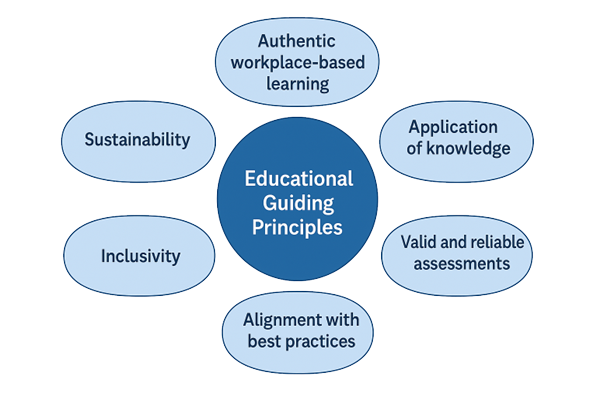
Implementation Approach
- Authentic workplace-based learning: wherever possible, NICPLD workforce development programmes will support learners to undertake authentic activities in the workplace. Practice activities will be used throughout to help learners to develop their professional practice, and to reflect on supervisor feedback regarding their performance (formative assessment). NICPLD will facilitate appropriate supervision for learners, including the provision of relevant resources to enable programme supervisors to support learners in the workplace. Practice activities will help learners to generate quality evidence which they can upload into their ePortfolio to demonstrate their achievement of the relevant learning outcomes (summative assessment). Simulated activities may be used in some circumstances where appropriate.
- Application of knowledge: eLearning, workshops and webinars will be used as appropriate to help learners to build underpinning knowledge to apply in their professional practice. Where possible, the NICPLD workforce development programmes will use a flipped classroom approach whereby learners may be required to undertake pre-work (eg eLearning) prior to attending workshops and webinars. Tutor recruitment will adhere to NICPLD quality management procedures. The workshops and webinars will provide opportunities for learners to apply their knowledge to practice-based scenarios. Where appropriate, group discussions will be used to facilitate learning. If feasible, learners will remain in the same groups for the duration of the programme to foster peer support.
- Valid and reliable assessments: ePortfolio assessments will be used summatively. Additional forms of assessment, eg OSCEs, written assessments, may be used as appropriate. Validity is achieved by assessing authentic evidence that has been generated by the learner to demonstrate their achievement of the relevant learning outcomes. No patient-identifiable information must be included in the learner’s ePortfolio. To enhance reliability, ePortfolio assessments undertaken by NICPLD use trained assessors and a double-marking/moderation process. Learners complete a declaration to confirm that the evidence submitted for assessment is authentic and their own work. Online plagiarism detection tools (eg Turnitin) may be used as appropriate for written assessments. Any suspected breach of academic, regulatory or professional standards will be managed through a concerns process by the relevant NICPLD workforce development team and, if appropriate, communicated to the relevant academic, regulatory or professional body.
- Alignment with best practices: the educational approach will adhere to, and be informed by, NICPLD quality management procedures, its AI position statement, and the requirements of relevant academic, regulatory and professional bodies. Programmes are co-designed in collaboration with a range of stakeholders, including employers. Learning agreements specify the responsibilities of all parties involved in the NICPLD workforce development programmes. It is normally recommended that learners do not undertake more than one NICPLD workforce development programme at a time.
- Inclusivity: NICPLD will endeavour to provide accessible, equitable and inclusive learning experiences that value and support the diversity of all learners. Equality, diversity and inclusion will be embedded through meeting the requirements of relevant academic, regulatory and professional bodies. NICPLD will design and deliver programmes that minimise barriers to learning and support accessibility for all. Where possible, the NICPLD workforce development programmes will start with a face-to-face induction workshop to promote psychological safety and inclusion. NICPLD will foster a respectful learning culture where all learners feel they belong. Programme content and delivery will also reflect diverse perspectives.
- Sustainability: NICPLD workforce development programmes will be designed and delivered in a way that supports environmental sustainability. This includes promoting both digital first learning approaches where appropriate, and sustainable learning environments, minimising unnecessary travel and resource use, and embedding principles of sustainable healthcare into educational content if relevant so learners can contribute to a resilient and environmentally responsible pharmacy workforce. Online webinars will be used throughout the NICPLD workforce development programmes whenever possible.
Review
- NICPLD will periodically review this position statement in line with its quality management procedures, and with relevant academic, regulatory and professional standards and guidelines.
- The NICPLD workforce development programmes will be reviewed annually, or more frequently if necessary. Advice and assurance on programme quality will be provided by relevant stakeholder advisory committees.
Glossary
Authentic activities: genuine activities undertaken in the workplace involving real patients and / or situations.
eLearning: the digital delivery of educational material.
ePortfolio: a digital collection of the learner's evidence.
Formative assessments: regular informal assessments aimed at providing feedback on performance and supporting ongoing development.
Practice activities: activities designed to help the learner to develop and demonstrate relevant knowledge, skills and behaviours. NB practice activities in the EL component of the QUB and UU MPharm courses are referred to as 'milestone' entrustable professional activities (EPAs).
Psychological safety: an environment of trust and mutual respect, where all participants feel safe to speak up, ask questions and share their views.
Reliable assessments: assessments that are consistent and replicable.
Summative assessments: assessments used at the end of a module or programme to evaluate learning against defined standards or learning outcomes.
Simulated activities: activities (eg role-play, digital simulations) that replicate real-world scenarios in a safe environment.
Valid assessments: assessments that accurately measure what they intend to measure.
Webinars: live online learning events.
Workshops: live face-to-face learning events.